
Explore why refrigerants are no longer a peripheral technical issue. Sitting at the intersection of design quality, regulatory compliance, operational cost and asset value, they are becoming a critical consideration across the built environment.
On this page, you will find a research white paper that showcases opinions and facts from across our industry about the changing commercial and financial impact of refrigerants in our buildings.
Collated into an easy-to-digest white paper aimed at commercially-minded readers, the paper draws on conversations with developers, architects, engineers and asset managers to understand current levels of awareness around F-Gas, practical challenges, and where momentum for change is beginning to build.
Contributors include The Crown Estate, Hilson Moran, The Langham Estate, TfL Property Group and SKArating.
With increasingly stringent regulations, evolving sustainability best practices, and heightened financial and asset scrutiny, F-Gas and forever chemicals are now critical considerations. They directly impact the environment, building compliance and asset value.
Read ‘What the F(Gas) do we do now’ to stay ahead in the conversation.
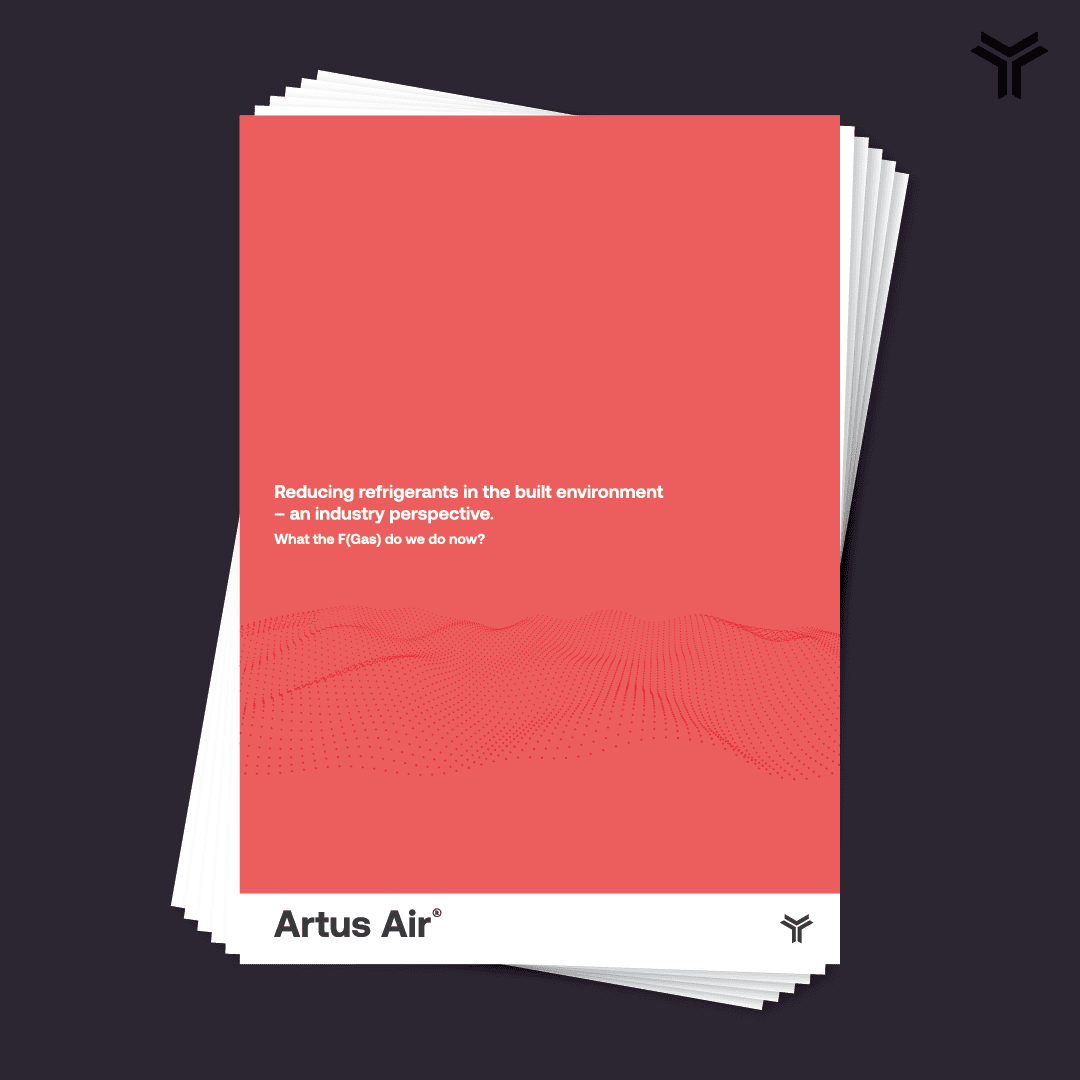
What the F(Gas) do we do now?
Explore how F-Gas regulation and refrigerant risk are reshaping commercial decisions across the built environment, from compliance and cost to stranded assets. Download for insight.
F-Gas is the most dominant synthetic refrigerant in the UK, existing as both liquid and gas in traditional HVAC systems.
Building services are making their way into conversations in investment decisions because:
Refrigerants are now a material investment risk. There is a growing disconnect between accelerating F‑Gas regulation and the continued specification of refrigerant-heavy systems across commercial portfolios. This means that buildings delivered or refurbished today risk becoming:
This creates unplanned capital reinvestment and erosion of asset value — regardless of original capex savings.
The following insights are drawn from conversations with industry contributors.
Refrigerants have long been treated as a purely functional part of building services, essential but largely considered ‘the default’.
That perception is rapidly shifting, as they are no longer a peripheral technical issue and now pose direct commercial and compliance risks, sitting at the intersection of design quality, regulatory compliance, operational costs, and asset value.
Key considerations for building design when working with F-Gases now include:
Refrigerants as a stranding risk by design. Specifications made today could create non-compliant outcomes within a single refurbishment cycle.
Building fabric optimisation first, system selection second. Too many projects start with system selection rather than first looking at the building fabric to see what natural improvements can be made.
The refrigerant knowledge gap and whole-life accountability. Consultants risk being positioned as reactive rather than strategic, with specifications revisited late as regulation tightens or asset strategies change.

Faraby Farid, Technical Lead for Real Estate Developments and Energy Strategy at The Crown Estate, speaks with Artus Air’s CEO, Rebecca Stewart, to explore how retrofit, system design and long-term asset thinking can help future-proof heritage buildings.
For readers looking to explore the themes discussed in more detail, the following resources provide further insight into regulation, asset risk, and refrigerant strategy across the built environment.
This paper draws on insights from across the built environment sector.
What’s your next project?
No matter what stage your project is at, we want to hear from you. Finding a solution to your challenge is our priority.
This product is protected by the following patents and other pending patent applications:
The Trademark ‘Artus’ is registered as GB 3220151.
The following designs are registered: GB 6350052 to GB 6350063 and EM 15052307-0001 to 0012